eBay Antiques · originally published

"Shannon Phila" Locks = Daniel Pabst?
"Shannon Phila" Locks = Daniel Pabst?

dressertop

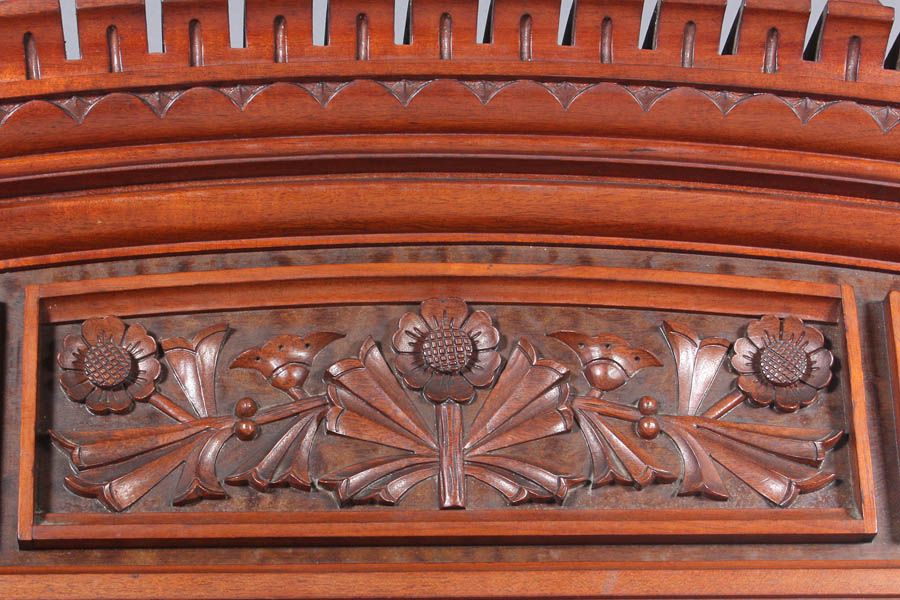
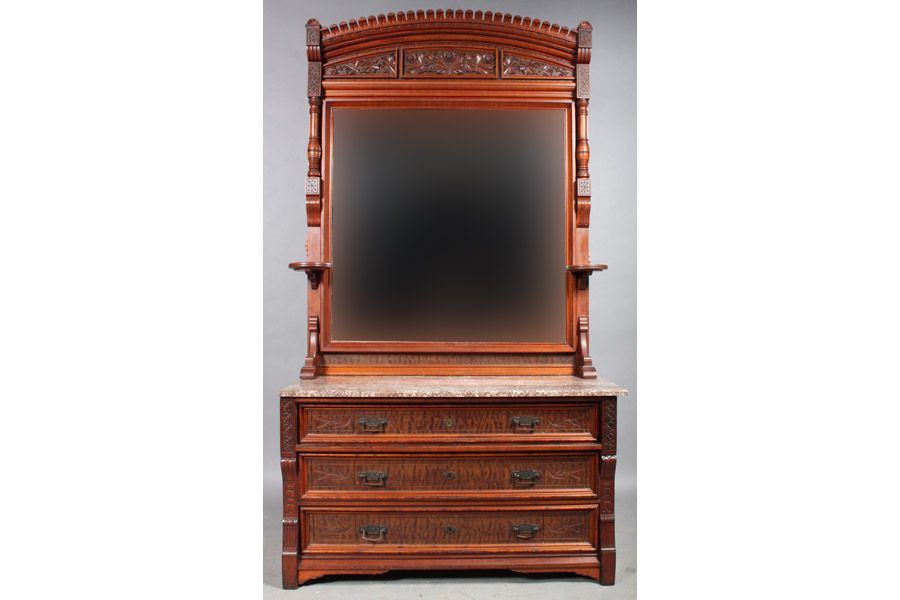
I ran into this dresser listing on Ebay which caught my eye due to the expertly done Aesthetic Movement carvings. What further caught my eye was a mention in the listing description of the presence of locks that bear the mark, "Shannon Phila". Shannon was apparently a manufacturer of hardware in Philadelphia at the time and it is often used by some as a sign that a piece was made by Daniel Pabst. The seller has not attributed this piece to Pabst, but I feel many who are familiar with his work would be tempted to. This piece has carvings that are on par with Pabst's work in my opinion. In speaking to an expert on Pabst about the Shannon hardware link, he mentioned that some of what we know as being Pabst's work has Shannon hardware and some does not. It cannot be used as a proof point that a piece was made in his shop. Common sense tells us that a hardware maker could not make a very good living supplying a single cabinetmaker's furniture. Regardless of maker, we can be nearly sure that this dresser was made in Philadelphia, not as much from the origin of the locks as much as we can from the overall design. The question is, might it have been made by Pabst, himself? You can see more about this dresser at the listing.
"Shannon Phila" Locks = Daniel Pabst?

10 comments

  1. zeke
    Hey John, Really nice dresser and the carving looks a lot like Pabst. Allen and Brother also used Shannon hardware, see this Southampton link: http://www.southamptonantiques.com/lc/lc-1192.html If you look at the incised leaf carving near the top of the dresser on the side posts, it's very much like the carving on the Pabst night stand on the cover of "Nineteenth Century Furniture" by arts and antiques. For that matter, the leaves also look a lot like the ones on the Allen lockside. I think we can safely say it's a Philadelphia piece, if not Pabst or Allen. One would think cabinet makers used local hardware suppliers. The dresser is also located in Woodstown NJ, which is very close to Philly. I am of the opinion that Philly Furniture, for example, is most commonly found in the Philadelphia area (Boston cabinet makers furniture in Boston area, etc.) This stuff was and still is heavy and hard to move and was more than likely sold to local familys. How much of it remains in old houses to be discovered one can only guess at!
  2. stever
    greetings--- alot of good common sense shared in both the article by john and reply by zeke. shannon hardware company was located in philadelphia, but how much they actually manufactured is anyone's guess. i own a 1888 shannon catalogue and it includes offerings from sargent & company, hopkins & dickenson and yale & towne(none of which are based in philadelphia.) it was very common for a firm to be a jobber for many companies as it increased the likelihood of being able to supply all of the needs required by the home builder and/or home owner. attributing furniture by maker and/or location using a hardware "link" only is not advisable. sure, furniture makers were probably more apt to buy locally unless a national company could supply cheaper! many hardware companies also made special goods (ie- corbin hardware designs can be seen on wooton desks) and many furniture companies put their names on items which they did not make themselves. i own a mortise lock, rosette and doorknob which are emblazoned herter brothers, but the items are much more likely to be made by hopkins and dickinson(new york) then herter! good call- stever
  3. zeke
    Hey Stever, Have you ever heard of a hardware company called "Farless & Boynton"? This company made the lock on a lockside chest and I would love to know anything about them, mostly what city they were in.
  4. RareVictorian
    Zeke, Boston, MA No. 147 Washington St. and 11 Cornhill According to the fire commissioner in 1883 they had a fire loss. Bottom of page 44.
  5. zeke
    Outstanding John! Thank you! I’m asking because I am trying to determine a maker or at least a city for my Aesthetic / Modern gothic lockside chest. I have seen 5 of these so far, mine in walnut, 2 more in walnut on the internet, one was auctioned through Fontaines, one in mahogany in the Swedbergs book “Collectors encyclopedia of American furniture” and one at Shore Antiques in South Jersey. The Shore Antiques example is a lighter wood, perhaps Elm? My lock on the rear lockplate has no markings on it, but the one in Shore Antiques is marked “Farless & Boynton. It looks Philly in style to me and both mine and the shore antiques examples came from houses in south Jersey near Philadelphia. The quality of construction is great and it was offered in at least 3 woods, all 5 have different but good quality brass pulls and all differ in details somewhat. Some, like mine, have a pullout desk as one of the drawers some not, but there are many subtle differences as well. I would think all were more or less made to order in a good cabinet shop. Now were they made in Boston and made their way down to NJ or was the hardware made in Boston and imported to Philly!? I think using the manufacturer of hardware is an iffy way of determining the origin of a piece of furniture. Great post John! Victorian detective work is very tough.
  6. Mario
    I have an 1870's ebonized modern gothic nightstand with large glass panels on 3 sides, back-painted with gold leaf and an aesthetic-stylized poppy bloom in varying shades of purple. Similar panels are found on Furness and Pabst's furniture including the cabinet at the Met, as well as on buildings including the Centeenial Bank, now the Paul Peck Center at Drexel U. Anyway, part of this unsolved mystery is that the lock is marked "C.A. Stock New York" while the piece looks unlike most New York pieces of the time, but very much like Philadelphia pieces, particularly Pabst's. I'm glad to see the post above confirming that jobbers like Shannon stocked hardware made outside of Philadelphia. If the gentleman with the Shannon catalogue or anyone else out there has run across the hardware manufacturer "C.A. Stock New York," I'd appreciate the infomation greatly. If you're interested in doing a post on the piece, I can supply pictures. Thanks. Mario
    1. John Werry
      Mario, somehow I missed your reply until now. Would love to see pictures of your piece.
  7. Errol Wade
    Greetings, I ran across your entry while looking for some info on C. A. Stock New York.... I have a writing table with a lock set in the drawer with that exact designation... my understanding is that it is about 1900..any more info on C.A.Stock New York? Thanks
    1. John Werry
      I couldn't find anything but I'd love to see pictures of the table.
  8. John Werry
    I did find a little on C. A. Stock & Co. They were located at 118 Wooster and were known as "Hardware Dealers". It seem that they were preceded at least in the 1870s by Stock & Haverman.

Leave a comment

Antique Searches Fixed

I haven't been using the Antique searches here on Rare Victorian ("Buy Antiques" link at the top of the page) in a long while and what I didn't know as a result is that most of them were broken. eBay changed the way the

No Reserve - Signed Alexander Roux Bed

You don't come across a signed, Rosewood Alexander Roux bed for $2k that often (current price with no reserve). It's not an overly grandiose bed in size or sophistication of design, but the carvings are exceptionally wel