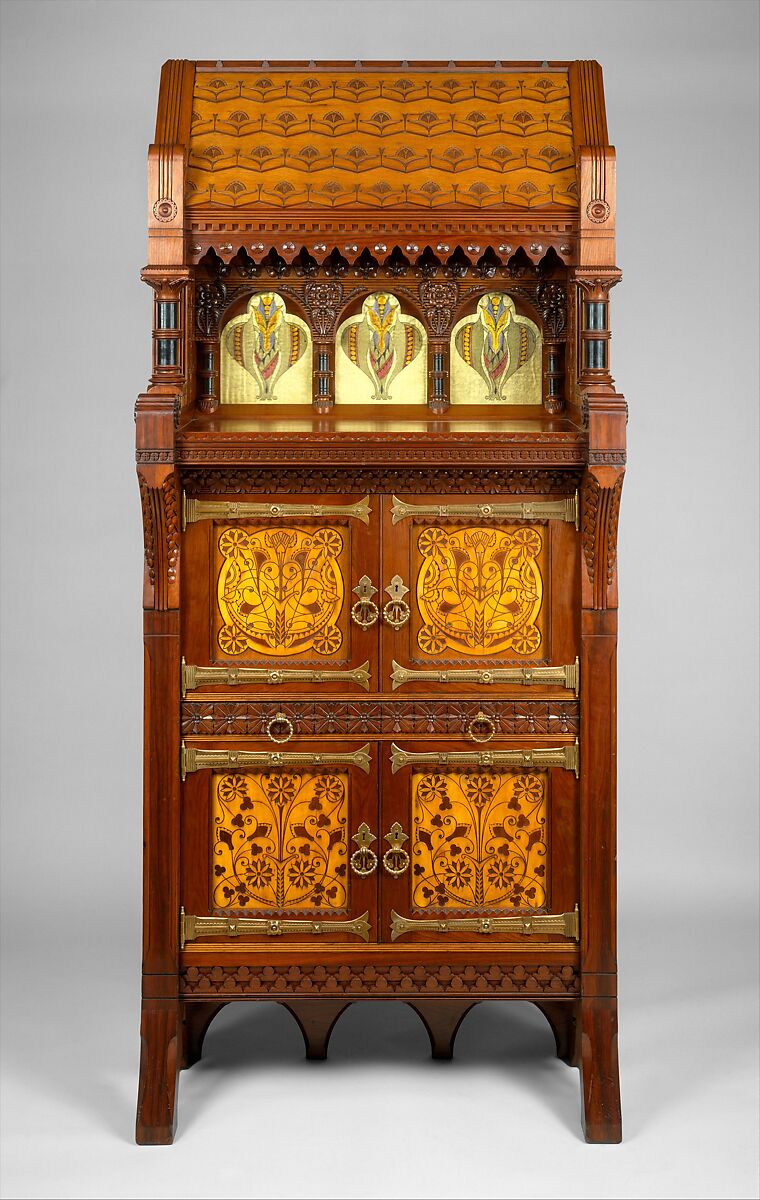
Daniel Pabst is not an obscure figure. Serious students of American Victorian furniture know the name, the Philadelphia shop, and the body of work. But when a Modern Gothic cabinet from his circle turns up in a general sale or an estate listing, you still see a shorthand that is worth examining: the attribution tends to read as "Frank Furness" without a qualifier, and Pabst's role as the maker who executed the piece disappears into the background.
The canonical example is the towering walnut cabinet at the Metropolitan Museum, about 1873–76, nearly eight feet tall with reverse-painted ribbed-glass panels, which you can see here. The Met's own language is careful: the design is "attributed to" Furness, the making is "attributed to" Pabst. That is the correct formulation — neither is confirmed by a label — and it keeps the distinction between designer and maker clear.
A related piece at the Brooklyn Museum, about 1875, does more of the attribution work. That smaller walnut-and-burl-ash cabinet is documented to Pabst by the museum's curators (here) and the shared vocabulary is plain: three-toed claw feet, ebonized column shafts, conventionalized tulip and floral panels, and the crisp silhouette Pabst brought to this kind of work after the Dresser-influenced design wave that hit Philadelphia at the 1876 Centennial. German-trained and working in the city since 1849, Pabst had the shop and the track record.
The point is not that the field ignores Pabst — it doesn't. It's that when you're cataloging or describing one of these pieces, the Furness label and the Pabst label answer different questions. Furness describes a design vocabulary and a patron relationship. Pabst describes the shop, the materials, and the hands. Both deserve to be in the sentence, and they mean different things.
Comments