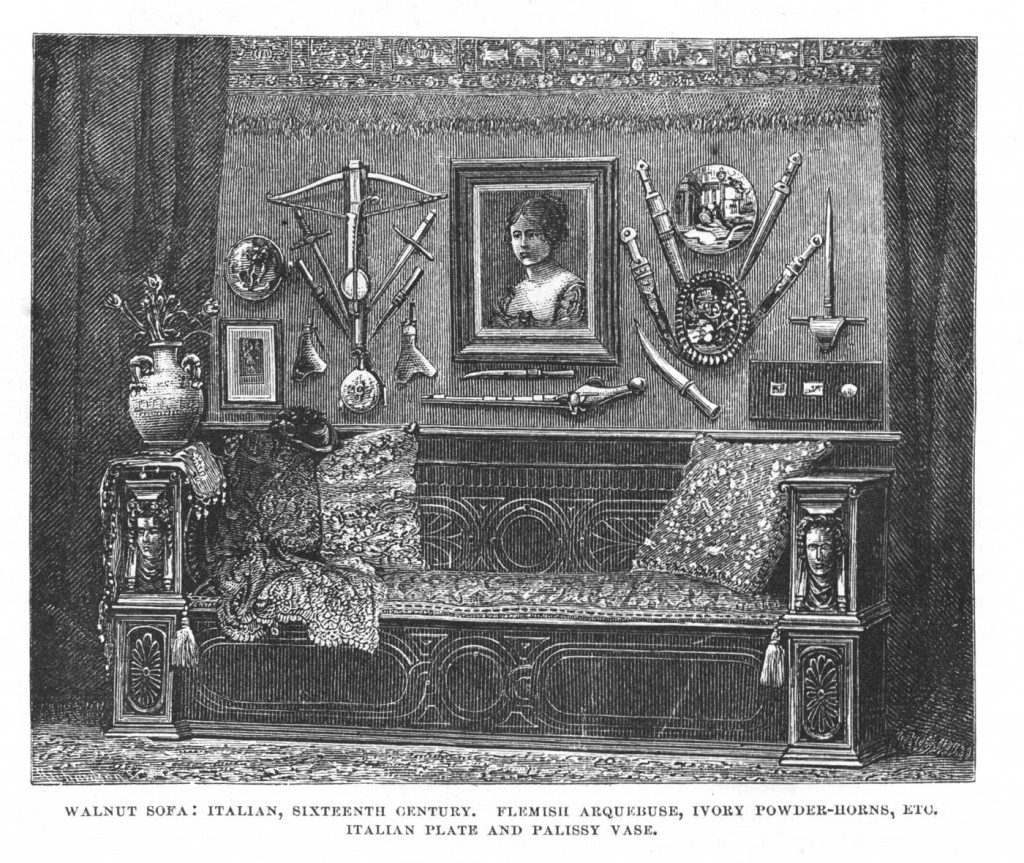
I'm thinking that maybe a 16th century sofa can end this Jenny Lind rumor for us, but let's review the ground we've covered on this topic for a moment.
In
this first post (yes, long ago), I announced a contest asking everyone for their own theories on the female heads carved into Renaissance Revival furniture. The question is, who was this imagery intended to depict? You had many theories centering on Greek mythological figures such as Athena, Columbia, and Helen as well as Lady Liberty. I did a post that
analyzed the Jenny Lind theory in detail and I
then explored the theory that the arms depict Helen of Troy based on a parlor set with some family history to that effect.
An interesting discovery that kills the Jenny Lind theory for good (for me) is evidence of these female busts occurring 400 years ago in true Renaissance-era furniture. The left image is from the sofa arm in the above photo and the right image is from the back of a Victorian-era Renaissance Revival bedstead.

The image is of an Italian Renaissance sofa from the 16th century as depicted in an article from an original 1877 Harper's New Monthly Magazine. The article in which the photo is shown is titled, "Furniture and it's decoration in the Renaissance". It has several very detailed images of Renaissance-era carved furniture (not 19th Century Revival-era). The presence of the female head on the arms of furniture in the 1500s also dispels any thoughts for me that she is Columbia, a much later personification of America first appearing in 1738.
For more clues I consulted the book, "
The United Symbolism of America" by Robert Hieronimus. There is an entire chapter on the Statue of Liberty which discusses the personification of America itself evolving over time and being inspired by Greek and Roman Goddesses. However, I didn't get anything from the book that I could hang my hat on with respect to identifying our furniture figure.
I consulted James Stevens Curl, architectural historian, who wrote the book, "
The Egyptian Revival. Ancient Egypt as the Inspirations for Design Motifs in the West". He is the author of several other books on Victorian, Classical, and Landscape Architecture, among others. Here is what he had to say about my direct query to him regarding these figures:
Classically-inspired female heads similar to these are not uncommon, and are found on many pieces of furniture, etc. I very much doubt if Jenny Lind was the Onlie Begetter of these items: one can find similar heads that are of nobody in particular, yet are attributed to X or Y on very flimsy grounds. The female Classical head was much admired (still is, in the few remaining outposts of civilisation that have not succumbed to vulgar popularism and vile crassness), and turns up in thousands of instances and guises. Helen of Troy was of course an important stimulus to art, as an ideal: so idealised females are often associated with Helen of Troy and other mythical beauties (the Daughter of Dymas, for example). There was, of course, The Egyptian Helen....but that's another story...
So, in essence, cobblers to Jenny Lind: the figure is simply a Classical Ideal.... We, who were weaned on Catullus, Virgil, etc., know of these things...
I think there were cases where a particular manufacturer marketed a parlor set as having a figure of Helen of Troy,
for example, in the cases where she is accompanied by a male counterpart (maybe Paris), but I just think that is marketing since we see the same figure used, as-is, without the male warrior profile.
I've compared hundreds of images of all the goddesses and each has her own defining features - a certain hat, a bow, a staff, a certain helmet - that without it, the unique identity fades away. With the Renaissance figure, we have no defining feature that is consistent and links her to a particular goddess. As James says, I think all we have are classical heads of nobody in particular - a "Classical Ideal".
I think I owe someone a book as promised in the first post. Not that I'm the final arbiter on this whole carved arms topic, but I think Joe came closest to my thoughts in his guess
here, so the long-overdue awarding of the book will go to him.
I think there were cases where a particular manufacturer marketed a parlor set as having a figure of Helen of Troy,
for example, in the cases where she is accompanied by a male counterpart (maybe Paris), but I just think that is marketing since we see the same figure used, as-is, without the male warrior profile.

6 comments