Nov 09 2009

Renaissance Revival Chairs With Marked Mounts

Published by John Werry at 8:49 am under Research

Egyptian-Revival

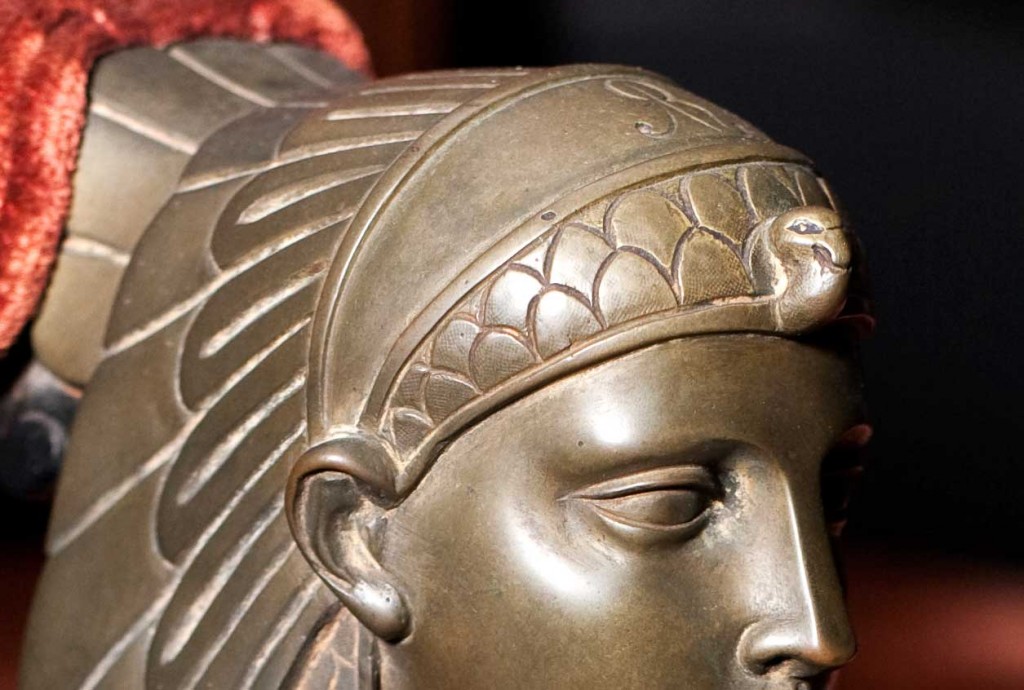
A recent Rare Victorian site visitor shared with me some images of a set of high-style Renaissance Revival chairs with very high quality mounts.  I have done a fair amount of digging on deciding whether the set is properly categorized as Egyptian Revival or Neo-Grec.  I have even consulted with James Stevens Curl who wrote the book on Egyptian Revival and his response was as follows:

the female head is not Egyptian, though it is influenced by Egyptianising figures: the uraeus has been replaced by what appears to be a bird, and the head-dress is not the Nemes of Egypt, but a sort of Red Indian concoction.

I was on the same path as Curl that the head-dress is not what is typically seen with Egyptian Revival.  There is almost seems to be a representation of feathers.  The ruffle around the waist of the figure also does not lend itself to suggesting Egyptian Revival.

So, for those of you who also like to nit-pick the details, what say you of classifying this set?  I’m almost tempted to leave it categorized at the “Renaissance Revival” level due to the lack of pure direction with the themes.

Have you noticed the markings on the mounts?  The winged globe (or disc) is an Egyptian motif, but is often disproportionately wider and is usually accompanied by uraei.  See here.  This piece is marked by “AR” and the female figures have an “R” on the top of her head-dress.  With the presence of “AR” and what looks to be a New York origin, one might be tempted to suggest it was made by Alexander Roux, but I question whether Roux would be that overt with his moniker.  The inside of the brass hooves on the chair feet are marked with an “R” as well.

Images of two the chairs follow in matching red upholstery.  There is a third matching chair of a different fabric and a non-matching sofa that I also hope to share in the upcoming posts.

I recommend hitting the full screen view via the icon in the lower right to see the set in it’s full glory:

Related items for sale - hover mouse for more information

rosewood-j h -belter-etagere
rj-horner-sofa-1890-
japanesque-mahogany-music-cabinet-signed-herter-brother
pair-of-1850s-laminated-rosewood-jh-belter-armchairs-
stunning-pottier-&-stymus-sideboard-1885-brown-rosewood
antique-mahogany-winged-griffin-r-horner-library-table
Related antiques for sale ...


Click Here To Learn How To Get New Posts Delivered To You Automatically!
Share/Bookmark

-->


Tags: , , ,

16 responses so far

16 Responses to “Renaissance Revival Chairs With Marked Mounts”

  1. monkecmonkedoon 09 Nov 2009 at 7:38 pm

    Beautiful set. Wild guess, but have you thought about Leon Marcotte as the maker as a commission by his brother-in-law Auguste-Émile Ringuet-Leprince (AR) sometime after his retirement in 1860 but before his death in 1886? The heavy use of ormolu gives it a Louis XVI meets Renaissance Revival feel.

  2. John Werryon 10 Nov 2009 at 6:25 pm

    Yes, I had contemplated it, but couldn’t match parts up with anything confirmed to be by Marcotte to be sure.

  3. Kirk Johnsonon 11 Nov 2009 at 2:07 am

    The combination of Greek and Egyptian elements makes me wonder if the mounts are intentionally Hellenistic. I would describe the style as neo-Ptolemeic (sp?), but I am making up that term. The rosettes are very Greek. The head at the top of the chair looks very Hellenistic – it could be inspired by art from Syria rather than Egypt. If the heads on the arms are intended to be Cleopatra VII, the ruffles make sense.

  4. Roberton 13 Nov 2009 at 4:14 pm

    Interesting that the bird head looks very much like the American wild turkey important to the Powahatan tribe of Virginia, the woman could represent Pocahontas with a crown and feather headdress, and the initials could be J. R. for John Rolfe. Could be it is a tribute to that Indian princess and her husband done in the neo-Egyptian style by an American cabinetmaker.

  5. james conradon 14 Nov 2009 at 2:19 am

    How about this? The furniture maker really liked these mounts and decided to install them on a line of his furniture.

  6. Kirk Johnsonon 15 Nov 2009 at 1:18 am

    The initials are probably the owners. Maybe the first names of a husband and wife. The practice was commonplace among European royals and nobility. Someone was probably imitating that practice.

  7. Roberton 15 Nov 2009 at 10:27 pm

    Jamestown, VA, was founded in 1607 as the first English settlement in America and every hundred years since, there has been a very large celebration with John Smith, Pocahontas, John Rolfe and Powatan playing large parts. Chances are this figure on the chair is related to the 300th anniversary of Jamestown in 1907. A huge celebration in Virginia, all sorts of things are made in commemoration of the event. If you look at pictures of Powatan, Pocahontas’ father, his crown was made of turkey feathers all pointed straight up and going all the way around his head like a hat, and he wore a floor length, wrap around cape made of glistening turkey feathers. If Pocahontas, AKA Rebecca Rolfe, wore a crown I am sure it would be based on classical designs incorporating features from her father’s crown made of turkey feathers as seen in the chair design and incorporating the turkey head on the front of the crown. The rosettes on the furniture are probably made to look like tobacco plants from a view above the plant in the ground. John Rolfe is widely regarded as the first tobacco farmer in America. Wasn’t so hard, was it?

  8. Roberton 15 Nov 2009 at 10:50 pm

    I forgot to mention the tobacco bundle on each side of the carved head on the back of the piece.

  9. Kirk Johnsonon 16 Nov 2009 at 1:26 am

    The style of the chair looks like it is 1880s or older. The rosettes and the bronze at the top of the chair are so close to ancient bronzes that they look difficult to date. The busts on the arms look late 19th century – after the Civil War. I suppose that they could be as recent as 1907. They look like they date from before WWI.

    The chair itself looks very old fashioned for 1907. You still might be right about the subject matter though. Pocahontas had wealthy descendants who might have commissioned this. There is no need for a date of 1907. Those intertwined initials make me suspect that this was made for newlyweds.

  10. Roberton 16 Nov 2009 at 2:35 pm

    1907 hypotesis aside, you are right. This could have been made at any time for a wealthy tobacco baron or one of Pocahontas and John Rolfe’s descendents like the Randolphs and Rolfes of Virginia to celebrate their ancestry or the tobacco baron’s wealth or business. Descendents of Pocahontas are very proud of their heritage. It has sheaths of tobacco, a tobacco plant, and what I think are tobacco flowers at the top of the leg/bottom of the arm at the front of the seat rack. I have seen flowering tobacco in South Carolina. The best of my memory the yellow flowers were on a long, curved shaft coming from the middle of the plant. I also believe I remember a similar crowned woman/Indian pricess with turkey feathers and tobacco sheathes being displayed as a symbol of a brand of tobacco or cigar in my early years. I am 71 and a lot of people smoked cigars and there were a lot of cigar stores when I was a kid.

  11. John Werryon 17 Nov 2009 at 10:04 am

    In the 19th century, Cleopatra was portrayed as having a bird on her head-dress, both the head on the front and feathers on the top and down the side of the head. This one from 1887 is an example

    The Death of Cleopatra was sculpted by Edmonia Lewis for the 1876 Centennial Exposition in Philadelphia. It is now in the collection of the Smithsonian American Art Museum. Note the chair arms. She also has the bird on her head.

    http://www.flickr.com/photos/cbustapeck/sets/72157600094746101/with/422646717/

    The chairs are certainly pre-1890; 1870s/1880s

  12. Roberton 17 Nov 2009 at 1:38 pm

    The artistic interpretations of Cleopatra you point to have her wearing the traditional head piece of the Ptolmeic dynasty, i. e., the broad gold band around the head with a cobra’s head at front center, and flanges on both sides of the face representing the spread neck of a king cobra. I don’t see any feathers, but I see the golden cloth that traditionally hung down behind the crown to cover the hair with splendor. Pharoah’s wore a similar head dress, but the head cover cloth was usually depicted as horizonially striped with gold and precious jewels. Maybe I don’t see what you see on these Cleopatra pieces, but the head on your chair has a bird head with a curved neck like a turkey on front of the head piece, not an Egyptian cobra, or that is the way I see it. I will also note, as an item of interest, that the freedom statue on top of the Capitol has bird feathers on its head, but they are slightly above the head on an extension of her helmet to replace the horse hair on the one traditionally worn by Minerva/Athena/Artemis. The feathers are laid back flat instead of pointing up. This eight ton statue is supposed to be a combination of European and Native American heritage united in peace but carrying a sword to represent vigilance. It is noted that Pocahontas influenced the statue. Two huge paintings, depicting events in Pocahontas’ life are presented in the rotunda of the Capitol. In the Civil War, some Southern units carried flags with images of Pocahontas with mottos like, “To Protect the Daughters of Pocahontas”, referring to all southern women. Thousands of people today are descendents of John Rolfe and Pocahontas, and her name has long been attached to the cultivation of tobacco.

  13. John Werryon 17 Nov 2009 at 1:45 pm

    Robert, both these images show bird heads and one the painting in particular has golden wings/feathers draping behind her ear.

    http://www.flickr.com/photos/cbustapeck/428904365/in/set-72157600094746101/

    http://www.artmagick.com/images/content/cabanel/hi/cabanel1.jpg

    I’ve noticed that regardless of ancient depictions of Cleopatra, her depictions from late 19th century art often have birds heads vs. the ureaus (snake) and since these chairs are 19th century, that seems to be consistent with the time period.

  14. Roberton 17 Nov 2009 at 6:53 pm

    I guess this lone symbol on the head dress threw me off. I imagined I saw two symbols because I expected them. The Ptolmeic and even earlier crowns of Egypt (see Tutankhamen ’s funeral mask) bore two heads at the center of the crown, the cobra of Wadjet, goddess of lower Egypt, and the vulture of Nekhbet representing upper Egypt. The wings on the side of the head were representative of either symbols of Nekhbet’s vulture’s wings, or Horus’ falcon wings. All three gods, Wadjet, Hekhbet, and Horus, were patron gods of the pharoahs. So this could be a headdress made up to represent only upper Egypt with either vulture or falcon wing stylized representations on the sides. Unusual as far as I know, but I guess not unheard of in late representations of an Egyptian empress. The double crown, and the combination of vulture head and cobra both represent unified Egypt. I have seen the cobra used alone, but not the vulture. Of course I am not an Egyptologist, so what can I say. Who knows? As a person who has majored in the classics and classical civilizations and studied early civilizations all his life, I know most anything is possible when dealing with representations of dieties. I wonder what Wadjet felt about being left out. The tobacco representations on your piece still point to Pocahontas, unless the turkey is a buzzard and the plants are sheaths of papyrus. I am open to either presentation, but side with Pocahontas and purely American symbolism.

  15. Kirk Johnsonon 18 Nov 2009 at 2:06 am

    The ruffles at the base of the busts are visually awkward, but if they are intended to be Cleopatra VII, the artist may have done that to indicate her Greek origin.

  16. Roberton 18 Nov 2009 at 3:34 pm

    After this, I will be quiet. It is interesting to note that Ms. Lewis, who carved the Cleopatra sculpture in 1876 was half black, half Chippewa and she grew up running in the woods with Chippewa children. After this particular statue’s display at the world’s fair, it was left in storage because Ms. Lewis could not afford to transport it to Paris where she lives, and finally sold, falling into disrepair as a display in a public barroom, a marker over a horse’s grave at a racetrack, and other odd places. It was tilthy and covered with graffiti, and pieces were broken off, probably including the whatever head protruding from the crown. A Boy Scout troop’s leader found it and the troop cleaned and painted it before giving it to a local museum. It then passed into the hands of the Smithsonian for their African-American section and was restored. I do not know if there were or are pictures of the statue in its original state, so I cannot judge the restoration.
    Art observers say Ms. Lewis incorporated African, Native American and her version of things Egyptian like the cloak of Isis that covers the body to express the power of women. The “heiroglyphic” writing at the base of the sculpture is from Ms. Lewis’ imagination and means nothing. The obvious wear on the surface is from exposure, not because the artist intended it to be that way. Very interesting and I am glad you pointed me toward researching this. Always glad to learn something new.

Trackback URI | Comments RSS

Leave a Reply

ALL comments go into moderation queue and all spam deleted so don't waste your time building links to your site.