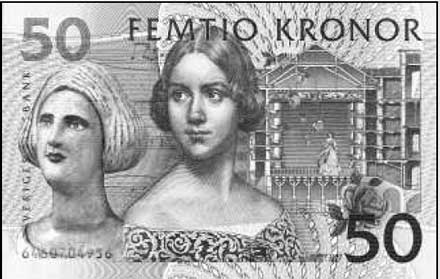
 If you haven't read the first part of this series on proving/disproving the Jenny Lind association with the carved arms on Renaissance Revival furniture, you can read it here.
This may take a few posts to get through, so let's discuss why the majority of people I've communicated with recently agree that these arm carvings are not Jenny Lind, but we first need to know a little bit about her life.
Jenny Lind (1820-1887) was a Swedish Opera singer, often referred to as the Swedish Nightingale due to her beautiful voice. After a performance in 1838, "Der Freischütz", she became wildly popular throughout Sweden and the rest of Europe for the period of about a decade. P.T. Barnum subsequently promoted her in the U.S. for 93 concerts where she earned approximately $250,000.
Barnum hyped her talent so much to the American public that "Lindomania" followed and she licensed her name for association with household items: beds, cribs, pianos, and music, among other things. The furniture generally associated with Jenny is of spool design.
It appears that the peak of her popularity was in the middle of the 19th century and the craze had subsided due to her relocation to Europe and raising a family in the 1850s. She continued to work sporadically, but not in the fever pitch that had occurred before. Her last performance was in 1870.
If you haven't read the first part of this series on proving/disproving the Jenny Lind association with the carved arms on Renaissance Revival furniture, you can read it here.
This may take a few posts to get through, so let's discuss why the majority of people I've communicated with recently agree that these arm carvings are not Jenny Lind, but we first need to know a little bit about her life.
Jenny Lind (1820-1887) was a Swedish Opera singer, often referred to as the Swedish Nightingale due to her beautiful voice. After a performance in 1838, "Der Freischütz", she became wildly popular throughout Sweden and the rest of Europe for the period of about a decade. P.T. Barnum subsequently promoted her in the U.S. for 93 concerts where she earned approximately $250,000.
Barnum hyped her talent so much to the American public that "Lindomania" followed and she licensed her name for association with household items: beds, cribs, pianos, and music, among other things. The furniture generally associated with Jenny is of spool design.
It appears that the peak of her popularity was in the middle of the 19th century and the craze had subsided due to her relocation to Europe and raising a family in the 1850s. She continued to work sporadically, but not in the fever pitch that had occurred before. Her last performance was in 1870.
Could the carved bust furniture have been a later, resurgent example of "Lindomania"?
I spoke to Alessandra Wood, assistant curator at the Barnum museum which has in it's collection many Jenny Lind household items (you can see examples of Jenny Lind items here though not from the Barnum Museum). After speaking with colleagues, the museum is leaning towards the carvings as not being of Jenny. They had not previously heard of this association with parlor furniture arms. "Looks nothing like her!" That's a refrain I've been hearing for the past few days from people writing and speaking to me. Many of your comments in the first post also are pointing in directions other than Jenny. One such person I spoke to was Peter Avrea, a 30-year collector and researcher who offers the advice to Google Jenny Lind and compare her profile to those on the carved bust arms. He thinks like me. So let's do a hard comparison. The female depictions surrounding the furniture arm in the center are those of Jenny Lind. the most important observation is that Jenny generally kept her hair cut short just below the bottom of her ears. The carved furniture arms seem to universally have much longer hair. It is rare to see a depiction of Jenny with long hair such as this one from the 1850s:
 I have not done exhaustive research on whether Jenny Lind took on an opera role that would have classical head ornamentation and longer hair, so there is always the possibility that she had one of these roles, but the rest of the reasons why it can't be her outweigh this possibility for me:
- The presence of short hair on Jenny for most of her personification in imagery vs. the long hair on the carvings.
- Her absence of popularity approaching and up to the time of the American centennial when a lot of this furniture was produced. There just isn't a compelling reason for her depiction during this timeframe.
- The narrow shape of the carved face and prominent nose does not represent the frequently depicted cherubic and rounded attributes of Jenny's face
11 comments