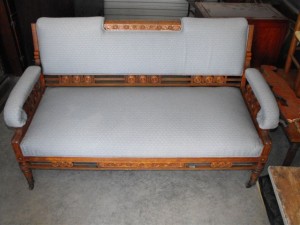
There was a lot of good discussion on the Parlor Set in the
last post that, by family history, had been designed by or is in some way associated with Stanford White. Cheryl (AKA misslillybart) found a photo that seems to be a dead ringer for this set pattern in the
Dickerson House photos, which was designed by McKim, Mead and Bigelow - who, very curiously (to me), were predecessors to McKim, Mead and
White - as in Stanford White. This new incarnation of the firm started in September 1879 when White arrived - after the house was finished.
Samuel White, who has written several books on Stanford White and is Stanford's great-grandson has seen the photos and believes it doesn't reflect the work of Stanford. Nina Gray, a curator of Victorian design (and Tiffany book author) does not believe it to be designed by White. Paul Tucker has also studied Stanford White's work extensively and is also in concurrence that it was not designed by White.
Thanks go to Paul for having the associations with the aforementioned experts and relayed their thoughts onto us. I'm always amazed at the contacts and knowledge of the Rare Victorian community. I often think that if any one person or group can solve a Victorian antique furniture mystery, the Rare Victorian community can. I'm grateful for the flow of opinion and fastidious research that comes my way from everyone.
So How Did White's Name Get Attached?
Dickerson died in 1889 and his son occupied the residence until 1910 after which he left for France. My question is: were the household furnishings sold off at that time while the building was being converted to stores, offices and apartments? Could this be the same exact set that furnished the house and then purchased by this family in 1911 when they got married?
I wouldn't normally jump to the conclusion that it would be the same exact parlor set, but the year of the conversion of the building to shops and stores coincides with the timing of their marriage (close - 1910 vs. 1911). The parlor set was made around 1882 (thanks, MLB), so this set was floating around for almost 30 years. It's not like this set was being mass-produced in 1911.
However, while it is a nice set, I don't necessarily think it is a one-of-a-kind set. It could have been produced in a larger volume than one. The timing of the house's demise and the wedding is just such a coincidence. The set was probably purchased in N.Y. From Ginny:
My guess would be New York. My grandfather was born in NY in 1884. He was a member of the Seventh Regiment of the National Guards in Ny and shortly after their marriage in 1911, they moved to Richmond. My grandmother was from Yonkers so most likely the set was purchased in Ny and according to the letter my grandmother wrote in the 60's to my Dad, there was 2 settees, 3 arm chairs and a ladies chair and they were done in pale green brocade. She mentioned the invoice was over $1,000.00 but that she could not find it at that time and I have not found in going through old letters etc.
Other than mentioning that the set was designed by Stanford White that is all the info I have.
If we imagine for a split-second that the set is one and the same as in the Dickerson photos (or even another McKim, Mead, and White/Bigelow house), I could see where a White association may have been attached to the set and lived with it and carried on for 100 years. This isn't a recent association to White made by an antique dealer or new owner in 1992. This was passed on by the one who bought it in 1911, so there must be some, even ever so loose tie-in to White.
If the set had been known to have come from a McKim, Mead and White house, the association with White might have stuck. White "was a skilled artist, capable of creating elegant details and brilliant arrangements of texture, color and objects based on unconventional juxtapositions", according to the
Buffalo, Architecture and History site. I doubt if anyone buying wedding furniture would do the research to see if it was created during Bigelow's participation in the firm or White's. The firm was one and the same, and at the time of purchase, it was White's name on the stationary and he was the "skilled artist", so.... one might assume.
In the end, I believe it was not his design. However, there is a shot that it came out of a McKim, Mead and Bigelow/White designed building and that is where the association came from.
Herter Brothers Link

Putting the White design association aside, there are those who commented on the previous post that believe that this set could have been manufactured by Herter Brothers.
If you take the foliate design in the skirt, isolate it, and compare it to Herter Brothers patterns, you won't get a match to those documented in the "Herter book". Making that comparison and coming up short does not prove one way or the other. It just pushes one on to look elsewhere.
I also have not seen the floral patterns on the side of the chair arms on any other Herter work. Again, this doesn't prove one way or the other.
One of the bases for the attribution to Herter by one of the commenters, "beerwineandcheese" was the casters:
For me, it was the brass conical caster rings that did it. I haven’t seen those on other makers. They are impossible to find.
I can't respond to that assertion, but I present it here as one of the concrete thoughts behind such an attribution. To me, attributions cannot be made on style and level of quality/craftsmanship alone. There must be concrete hallmarks present in construction or carving, or labels/brands, bills of sale, etc.

6 comments