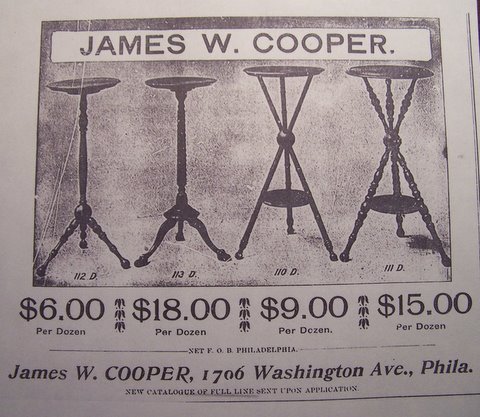
In case anyone runs across one of these Hunzinger-looking pedestals, they were actually made by Philadelphia maker James W. Cooper. You may have already viewed his
"Art Furniture" catalog here on this site. Paul Tucker, who shared the image with us, found the photo in an issue of American Cabinetmaker and Upholsterer.
"The Philadelphia Furniture Industry, 1850 to 1880", is a dissertation written in 1980 by Page Talbott and it is available for purchase/download
here.
According to the dissertation, Cooper set up shop as the sole worker in 1850 after leaving the cigar-making business. He felt that there would be a strong market for furniture like those previously imported from Germany and Switzerland. Within 18 months, the demand for his furniture forced him to move to bigger quarters. There were several subsequent location moves until 1875 when he built a new factory at 17th and Washington Ave.
Talbott quoted the following description of the factory from Charles Robson's,The Manufactories and Manufacturers of Pennsylvania in the Nineteenth Century Philadelphia: Galaxy, 1875:
The lower floor is the counting-room, and the upper contains the drafting and designing room. the engine and boiler occupies the ground floor, and above all this the 'machine carving' is carried on. The main building is five stories high. The first floor is the sawing and ripping room, the second floor is the turning shop; the third and fourth floors are used for putting together and finishing the cabinet wares; while in the upper story a large number of the most skillful hand carvers are constantly engaged. From the third story a bridge extends to the rear building which contains the gilding and ornamental rooms, 26 together with the packing and shipping department.
I also received permission from Page to share the 1877 factory layout for Cooper's operations from her dissertation. Notice the first floor engine room, where Page explains there was a 20 HP engine, presumably steam, to power a lathe and carving machine. Though he had machinery, he also employed skilled carvers, presumably from the local German population, for the finishing touches. You can click on the image to expand it's size.

3 comments