
I'd like to get back to the series of posts on issues with using furniture books, catalogs, and ads as proof-positive sources for furniture maker attributions (
Trade Catalogs Can Be Misleading;
Don’t Believe All That You Read).
Another complicating factor is that many furniture makers were also retailers of other makers' wares. They augmented their personal offerings with those of others - both imported from abroad and from within the U.S. We saw that in one example, Prudent Mallard of New Orleans
resold Kilian Brothers tables, labeling it as a Mallard piece. The Victorian Details book presents a theory that George Henkels may have resold
furniture by Ignatius Lutz. Alexander Roux imported furniture from France. R.J. Horner imported furniture for resale ... the list goes on.
Which makes me wonder about the chair that I own, shown above to the right.
As we saw in my trade catalog post, there is confusion of this chair's maker due to the use of "standard" woodcuts by furniture makers in their catalogs. If you remember, this general chair design shows up in
Henkels ads and J.L. & G.A. Hazard ads.
Adding to the confusion is the fact that there are labeled chairs in this overall design by Charles H. White (one is below). This chair, made of mahogany, has the label including White's name and address, dating the chair from 1852-1857. According to the August 1983 issue of The Magazine Antiques, chairs of this design were $25 to $35 in his 1854 catalog.
The article goes on to say:
A similar chair, attributed to George J. Henkels is in the Philadelphia Museum of Art and a set of four similar chairs at Loudoun in Germantown is attributed to Klauder, Deginther and Company of Philadelphia on the basis of a bill of sale of 1854.
So we have Henkels, White, and now Klauder, Deginther and Company tied to this chair design.
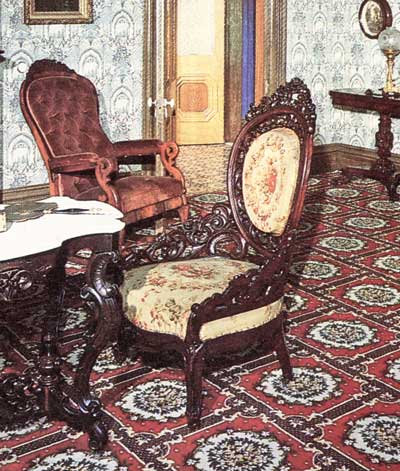
This is not the only chair design that has a Charles White and George Henkels connection as was documented in
this past post. Since both of these makers did their business in Philadelphia, it isn't unreasonable to suggest that they were collaborators in some way.
But wait ... there's more ...
"Decorative Art of Victoria's Era" by Frances Lichten documents that this chair, below, was made by Robert Renwick of Baltimore. Unfortunately, there is no further substantiation - no label, bill of sale or other reasoning for Lichten's claim. Note that it isn't even an attribution - it was "made" by Renwick.
I don't discard Lichten's Renwick association but I am suspicious of it due to the lack of physical proof (label, etc.) and the 1950 publishing date of the book. This was a time that everything made by Meeks was a "Belter". Until I saw this book, I thought at least I could say that the chair was most likely made in Philadelphia, even if I couldn't pinpoint the maker. But now the specter of Baltimore's Renwick is added to the list. I've written the National Gallery of Art to see if they have some records on the chair.
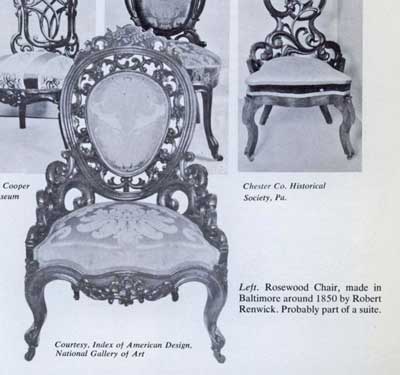
It is important to note that there are some differences in these chairs. The overall form is so unique with it's heavy carved side bolsters and floating upholstered medallion that it tricks the eye to ignore the details. The pierce carvings in the back vary. The skirt carvings can vary. The presence and execution of roses in the crest can be a differentiator. The upholstered medallion in the back is sometimes symmetrically elliptical and sometimes is egg-shaped as in the case of the "Renwick" chair.
Some are mahogany, some rosewood, some walnut. I won't assume the difference in composition necessarily points to different makers. If Charles White had prices from $25 to $35 for his chairs, wood selection can be one reason for the price spectrum.
Unfortunately, there is no end to the research on this chair despite my best attempts. However, I hope that I have provided a case for caution when using reference material. One cannot use any single source to nail down a maker. Just when you think you have comfortably associated a maker by finding it in one book - that other unopened book on the shelf may tell a different story.
3 comments