Research · originally published
Trade Catalogs Can Be Misleading
I hadn't intended yesterday's blog post to be first in a multi-part series, but as I lay awake last night after dealing with a sick puppy, it occurred to me that I had been saving up a bunch of material for a post on George Henkels and it actually fit in well with this line of discussion.
The last post dealt with inaccuracies in antique reference books where the collective knowledge of the antique community came up with a different conclusion about a particular piece or set than what we have concluded today. It dealt with the fact that in decades past, Meeks furniture was often mistaken for John Henry Belter furniture and it was published for all eternity in books from the mid to third-quarter 20th century. But the Belter/Meeks confusion is only the tip of the iceberg.
Another related issue with believing all that you read is the problems with trade catalogs from the time. Yes, the one resource that you would think would be the silver bullet for identifying the maker of a piece of furniture cannot always be trusted.
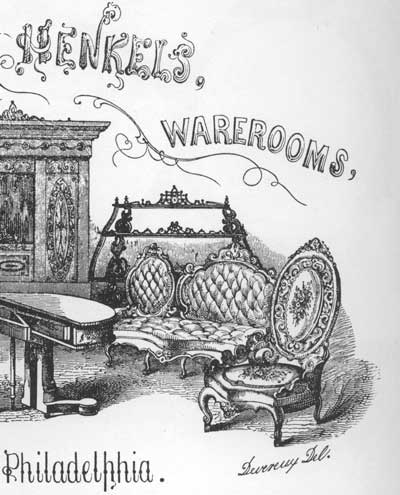
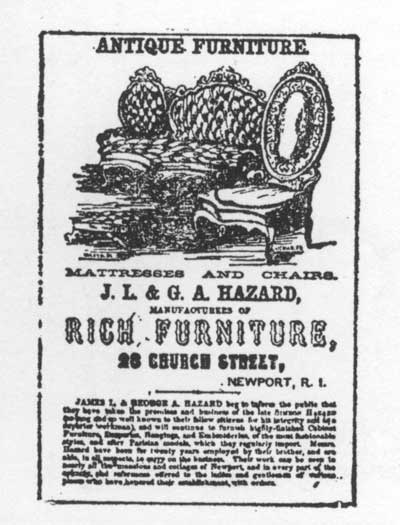
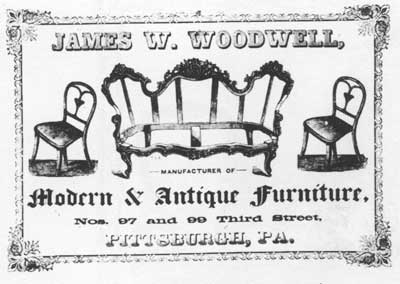
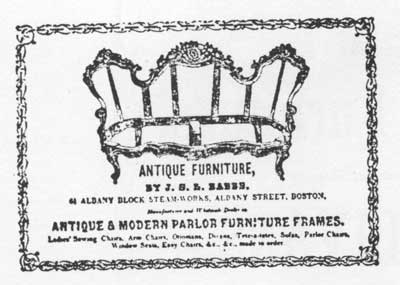
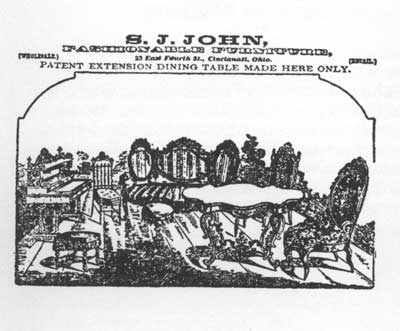
According to and clearly demonstrated by the Victorian Details book, many trade catalogs and advertisements during the 19th century used woodcuts for printing. These woodcuts were sold by engraving companies to many manufacturers and you can see evidence in the photos below. George Henkels had the same sofa & chair woodcut as J.L. & G.A. Hazard. Woodwell (3rd image) used the same sofa woodcut as the manufacturer in the bottom image.
The scary part is that the presence of the furniture in an ad for a particular maker is not only confusing due to the presence of the same image in other manufacturer's advertisements, but it can only be used as a stylistic reference - not a guarantee that the maker actually made that exact specimen at all.
The makers used mass-produced woodcuts sold redundantly across many makers so that they could demonstrate general styles to their potential customers. It was cheaper to purchase a "standard" woodcut than to have it custom-made to represent one's own specific furniture.
The engraver probably based the master woodcut on furniture from one particular maker or designer drawing as a reference. One can assume then that this depiction will not match the furniture of the myriad makers who purchased these woodcuts for printing their ads and catalogs.
I have gut feel observation that things got better towards the 1870s and onward, but would need to do some research to confirm this. It seems the redundancies occurred in the 1860s and prior.
So I wrap up part II saying that you shouldn't take these historic images as a definitive reference for a particular maker's wares. I also have enough material for at least a part III, so stay tuned ...
Leave a comment
Related archive entries
"Based On The Quality of Work" And Other False Reasonings
There are a lot of methodologies that people use to identify a particular piece's maker, but few of them drive me more bonkers than "based on the quality of the work it surely was made by so and so". Relative to what? Ho
George Hunzinger Receipt
I recently purchased this original George Hunzinger receipt from 1900, which is two years after George Sr's death. Notice the "& Son" in the logo. I assume that this is an example of Hunzinger wholesaling to another
1 comment