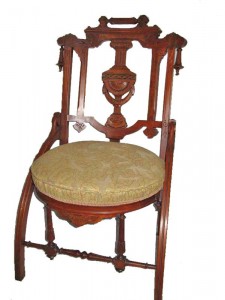
Continuing from where the
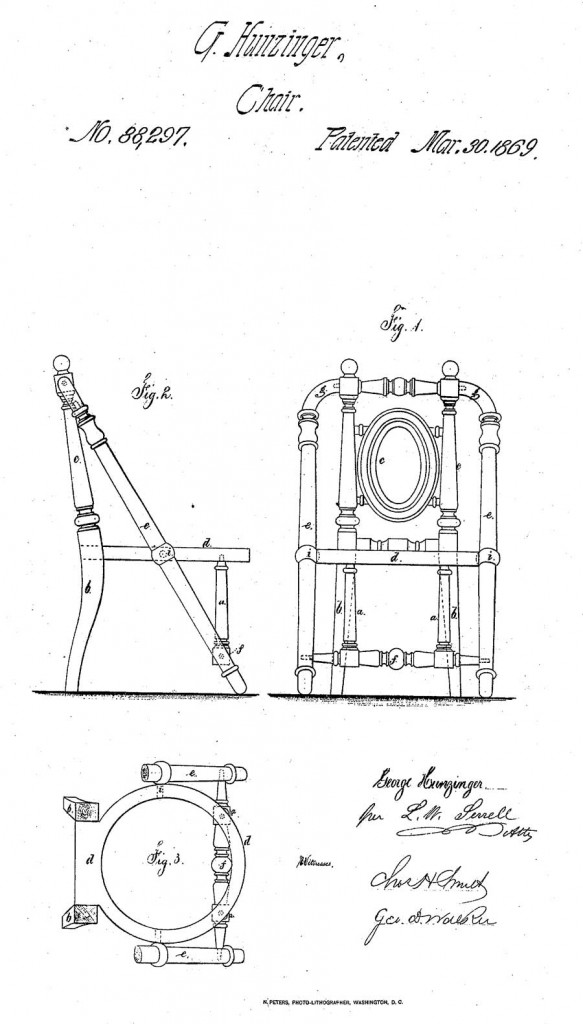
last post left off,we were trying to determine if an unlabeled chair that Zeke Feldhaus recently purchased was produced by George Hunzinger due to the patent-protected brace design (very bottom image) in the chair or whether another manufacturer either infringed on his patent or perhaps had licensed it.
Zeke had also ran into
another instance of the chair which has a variation in the back splat but is certainly from the same manufacturer. I wrote the owner to ask how they came to the conclusion that it was a Hunzinger and learned that it was based on word of mouth from the prior owner as well as some dealers who had seen the chair.
The Bruschke & Ricke Angle
Zeke ran into a particularly
movie-like story about the Bruschke & Ricke's firm's demise (the firm that Barry Harwood suggested had some designs that are reminiscent of Zeke's chair). The business was lost after Bruschke shot and killed a striker, injured another, and burned a small girl via the powder from the shots. This was in May of 1886, one month after the expiration of George Hunzinger's patent for the leg and brace expired.
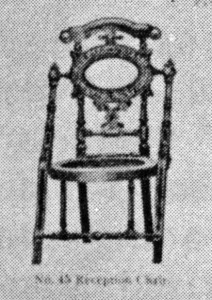
That didn't leave Bruschke & Ricke but one month to have produced the chair design legally after Hunzinger's patent expiration, if it was indeed produced by them. The other option is that they had licensed the design. An interesting bit of research would be to see if Hunzinger ever licensed any of his patents.
Barry mentioned to me the existence of an original catalog at Winterthur Library for Bruschke & Ricke which showed a Renaissance Revival chair with Hunzinger-like brace design. That chair is shown to the left, taken from "Accumulation & Display: Mass Marketing Household Goods In America, 1880-1920". Although it is not identical, it does show another manufacturer producing, or at least retailing, a chair with the Hunzinger brace design.
So far, I haven't seen anything that says Brushke & Ricke produced Zeke's chair; only that it is possible.
Unmarked Renaissance Revival Hunzinger Furniture
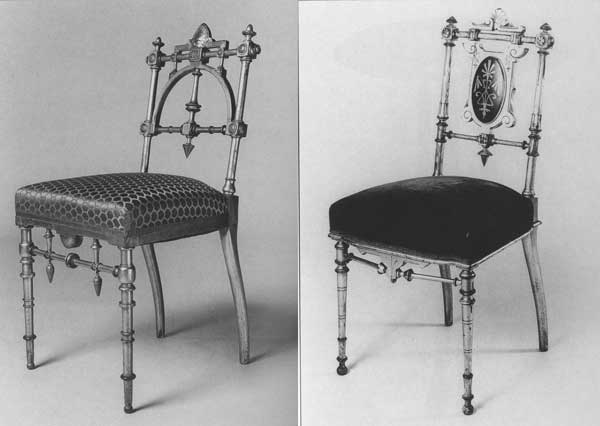
Barry Harwood's Hunzinger book shows some unmarked Hunzinger that are more mainstream Renaissance Revival style than many of his other, more inventive designs. He explains that "most surviving examples of Hunzinger furniture incorporate one of his utility patents and are impressed with his name and patent dates".
However, he goes on to explain that during the 1870s he made a small group of fancy parlor chairs in the mid 1870s that are apparently unsigned. However, they are confirmed Hunzingers due to the existence of closely related chairs in Kimball's Book of Designs from 1876 which documents some of Hunzinger's furniture. This tells us that we cannot assume that all Hunzinger's work is signed.
Continued in Part III ...

Comments