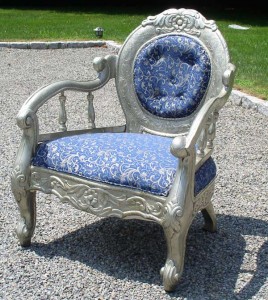
Paul Tucker found what I believe to be the likely explanation behind this metal-clad armchair that was discussed
several posts ago. Paul ran into a patent filed by Erastus W. Whitlock.
A drawing included in the patent application depicts a metal-coated bed post whose core is made of wood. The purpose of the patent was to declare a new alternative to solid metal (brass) beds and furniture. Brass furniture had a very pleasing appearance but was very expensive to manufacture, lacked rigidity, and when transported was very likely to sustain knocks and dings. Per the patent application:

Therefore it follows that to provide articles of the class specified, which while having all of the pleasing and decorative qualities of brass or analogously-formed articles also have that solidity and rigidity which is not present in tubular articles as usually placed upon the market, and at the same time to furnish such an article at materially less cost than such tubular articles, constitutes an important advance in the art.
... In practice I have found that lead-foil is well adapted for the purpose, This foil may be placed, usually in sheet form, upon the core in any desired manner, as by pressure-for instance, hydraulic pressure-in which case the metallic sheet-and the wood are immersed in a tank or tube of water and the parts hermetically sealed, so that the water will not get between the metal and the wood, Whereupon the water is placed under the required pressure, thereby forcing the metal or foil into all the crevices and shape of the wood and completely covering the wood and fixing the foil rigidity hereto.
I would assume that this chair was manufactured by applying the process described in Whitlock's patent. Thanks, Paul, for the heads up.

3 comments