
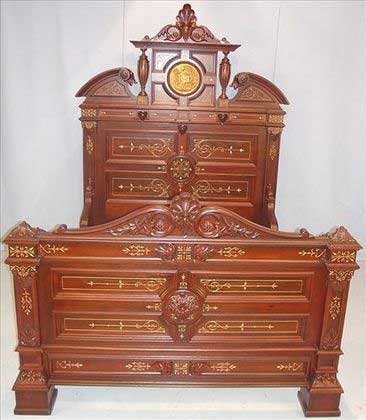
I was contacted by the recent buyer of the above bedstead, which is part of a two-piece suite. There is no question it is a very desirable set and I'd be happy to have it in one of my bedrooms. It is constructed of solid Rosewood, has gilt incising and a bronze plaque inset into the headboard.
The buyer contact me to see if I had any opinions on whether it was Allen & Brother, which was the attribution during the sale, or Herter brothers as had been seen on a similar bed sold recently as well.
One aspect of the design of this bed stood out for me as something that needed further research - the
broken pediment. I have heretofore not seen either a Herter or Allen piece exhibiting a broken pediment, let alone one terminating in rosettes.
I have a Rosewood and Ivory inlaid cabinet that I believe to be an English piece that demonstrates a similar broken pediment style and from my research is representative of "Queen Anne" revival from the late 19th century. Not a style I've heard much of in the American Victorian decorative arts timeline.

Anyway, I'm not suggesting yet that the bedroom suite is not necessarily American, I just feel that a jump to Herter or Allen & Brother attributions might require further dissection. The bedroom set is highly desirable however, regardless of maker.
As a side tangent, I continue to be concerned with the state of attributions and the upward impact on price for the buyer and the potential for lost history. Here's a
recent example.
Turned furniture is not always = Hunzinger; aesthetic, ebonized, inlaid furniture is not always = Herter Brothers; hunt sideboards are not always = Alexander Roux; Modern Gothic with strap hinges is not always = Kimbel & Cabus; laminated Roswood parlor furniture is not always = Belter ... I can go on forever.
With hundreds or thousands of makers active at the time in EVERY major city throughout America and Europe, each copying each others' work and using the same commonly available design guides published at the time, it's a wonder we can determine who made anything without a label or stencil or tag.
4 comments