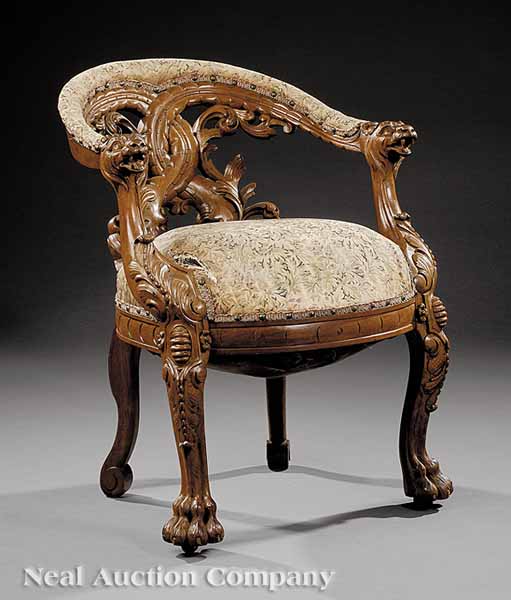
I was watching
this chair during the Neal Auction sale and was very interested in the notation that was added to the catalog and the lot detail on the Neal website that didn't make it into the Ebay text. I have provided the notation below:
An Important American Rococo Walnut Armchair, c. 1855, Philadelphia, bearing discovered stamp on top inside of proper right leg "C. W. and Co.", probably for Charles H. White, the padded crest above an exuberantly carved back exhibiting entwined dolphins amongst scrolling foliage; their tails continuing to robust animal mask terminals, curved arm supports, cabriole legs headed by cabochons, ending in paw feet, height 32 in., width 25 in., depth 21 in. $2000/4000.
The design for this chair is well-known, though this chair apparently is the first example with a maker's mark. A drawing of a very similar chair appears as the frontispiece in Edward Strahan's Mr. Vanderbilt's House and Collection. Boston: George Barrie. A photograph of William Vanderbilt sitting in the chair is illustrated in Howe, et. al. Herter Bros., Furniture and Interiors for a Gilded Age, p. 201.
A very similar chair installed in the library of the c. 1860 Asa Packer Mansion in Jim Thorpe, Pennsylvania is illustrated in Kenneth Ames The Magazine Antiques, "George Henkels, Philadelphia Cabinet Maker" Oct. 1973, p. 645, fig. 9. Henkels, whose large firm was at 172 Chestnut Street, blocks away from White's workshop at 250 Chestnut, was credited for the Packer library chair before the discovery of the label on this chair came to light.
Few objects made and sold by Charles White (Philadelphia, 1796-1876) are documented. A carved walnut armchair conserved by the Carnegie Museum bearing a stenciled label "Chas. H. White, No. 250 Chestnut St. Phila_", differing slightly from that on this lot, is illustrated in Busch, et. al. Rococo, the Continuing Curve, p. 200, fig. 9.
Assuming we take it that "C.W. and Co" refers to Charles White and not another maker, this is indeed an important find and the $4,500 this chair commanded is a testament to that.
I haven't yet digested the possible implications of this find, but certainly one of the results could be that all the grotesque furniture in the Asa Packer Mansion could become attributed to "C.W. and Co" as the maker (though sold by Henkels as they have always maintained).
Although this chair is marked, "C.W. and Co", let me confuse you further by providing this excerpt from the Magazine Antiques article mentioned above.
In the Packer mansion there are two chairs (Fig. 9) like that on the left in Figure 4. Homestead Architecture comments that the chair was a recent "importation from one of the best establishments in Paris".
You can see the figure and Parisian attribution in Samuel Sloan's Homestead Architecture book yourself by downloading the now
public domain Acrobat version from Google. See pages 360 and 361. Sloan was a prominent Philadelphia architect at the time and is known to have used Henkels furniture in the book. It is also suggested by the Magazine Antiques article the Henkels himself may have written the furniture section of the book (Henkels was also a prolific writer at the time).
So is the chair manufactured by Charles White or an as of yet unidentified Parisian manufacturer? The statement in the Sloan book could be marketing spin and the true maker could indeed be White. I'm ordering a copy of the Rococo book mentioned by Neal so that I can see the other "differing slightly" chair that is marked "Chas. H. White".
One final note of interest from the Magazine Antiques article:
Henkels' illustrations must be treated with caution. While they may accurately represent furniture in his warerooms, the woodcuts are copied from other sources, primarily the Paris publication Le Garde-Meuble Album de l'exposition de l'industrie, 1844, which is a useful compendium of the best contemporary French design.
This was in reference to the catalogues and booklets that he wrote for his customers: "A Small Catalogue of Furniture in Every Style", and "An Essay on Household Furniture".
4 comments