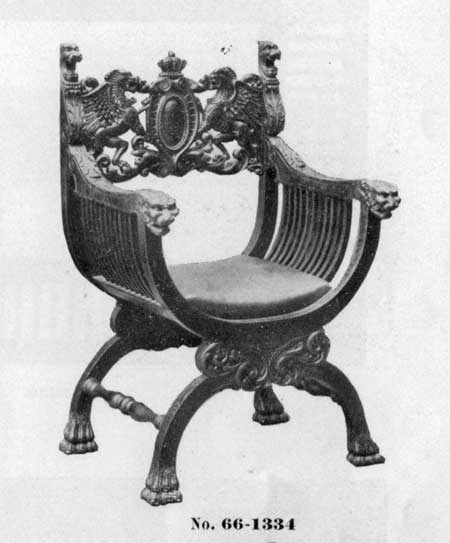
I purchased a chair a year or so ago at a local auction to go along with my Horner hall chairs. I had previously seen this chair attributed to R.J. Horner and, considering the griffin carvings, I never thought twice about that attribution (like I now instinctively do with everything). It turns out that it was made by the Robert Michell Furniture Co. around 1904 as it is in their catalog that I recently acquired (image above). It is their model #66-1334a, “Roman Arm Chair”, solid mahogany, $74. It was also available as #66-1334 in quartered Oak, golden or “Antwerp” finish, $64 (I wonder what Antwerp implies color-wise). The upholstered seat was covered in leather. Mine is below.
The griffin arms and the finials on the chair are distinctively carved and you will see these elements independent of one another on other pieces and these can help distinguish Robert Mitchell pieces. There is a possibility that R.J. Horner made these chairs for Robert Mitchell and I leave that possibility out there, but barring any new evidence beyond this catalog, I will heretofore assume they were produced by Mitchell.
By the way, Robert Mitchell is one and the same as the Mitchell from Mitchell & Rammelsberg. The company was renamed Robert Mitchell Co. in 1881. Robert Mitchell biography.
The longer I research furniture, the more I see how dramatically lopsided attributions are made to the incorrect side. There is a pandemic in my mind to the point where attributions are getting worthless. Take a look at the following image from the same Robert Mitchell catalog. For those of you who follow R.J. Horner furniture, how many times have we seen this Mitchell table labeled Horner?
In one of my next few posts, I will show you how to identify an authentic R.J. Horner hall chair.
Related items for sale - hover mouse for more information

{ 2 trackbacks }
{ 11 comments… read them below or add one }
Hi!
“Lopsided” is an excellent description of current state of attributions. What ever happened to the phrase “in the manner of?” It seems that using the words “in the manner of” leaves the door open for further research. As you so well know, there is SO MUCH info we have NOT yet uncovered about Victorian Furniture and its makers.
Looking forward to your step by step analysis of how to ID a Horner vs. other similar furniture! Charles.
It’s funny drew, as I look at books from the 60s and earlier, everything Rococo parlor-wise was a Belter. Almost all the Meeks stuff was called Belter. And mostly in the context of “this is Belter” and not “Belter style”. Today we just know more names to mis-attribute things to. At any given moment in the 19th century in the major cities, there could be 400 furniture shops churning out furniture.
Charles, I have it 1/2 written so should be ready in the next few days. The time consuming part is the taking, cropping, lightening, editing, combining of the images… But I think this should be the definitive article on Horner Hall chair identification (probably because it will be the only one
).
Just be glad they didn’t throw in Hunzinger’s name as well. I can’t even tell you how many pieces read: Horner / Hunzinger chair. They will throw in Hunzinger’s name with anything, just to get the search hits.
From the “Household Decoration” advice column in Harper’s Bazaar, January 1905:
“Fumed oak is the lightest and warmest in tone. It is similar to walnut, a rich nut brown. Weathered oak is a cold brown, darker in tone than the fumed oak, but lighter than the Flemish and Antwerp oak, both of which are very nearly black.”
Perfect, thanks misslilybart. Makes sense because if you’ve ever seen the “European Container” antiques, there’s a lot of that dark oak.
One random point about the chair – there is “634″ in white chalk on the seat back. Not exactly 66-1334, but maybe its some kind of shorthand for it.
Southampton Antiques has a Mitchell arm chair like this one for sale right now ($1,650) No attribution, mention of any maker. http://www.souhantq.com/os/os-1091.html woodwright
Funny you raise this particular topic in June of this year. I have been researching the Mitchell firm and submitted a book on Mitchell ca.1895-1910 in March. It is currently being reviewed by the publisher.
The distinctions between Mitchell and Horner are many… and the whole Mitchell v. Horner issue has been a bee in my bonnet for two years now. While this subject is too complicated to rewrite here, I can confirm from my research (at Winterthur and the Met as well as the marketplace) that most of what has been named as a Horner piece of furniture without a label is highly suspect and I can site several examples that are illustrated in Mitchell’s catalogs (including “Dutch marquetrie” parlor tables. I should add that the lines between retailer and manufacturer become blurred for many furniture concerns ca. 1900. If you have a particular question, please let me know at staforlife@yahoo.com
ON A SIDE NOTE ABOUT HORNER… do any of you know about Princess Metternich’s salon furniture? The NY Times states that Horner reproduced her furniture and had it on display in his NYC wareroom. Metternich had residences in Vienna, London… unfortunately I cannot figure out WHICH pieces were reproduced.
Best,
Ware
Glad to hear there will be a book out there to help clear some of this up. Welcome to the site and you can be sure I’ll send you an email at some point with a Mitchell/Horner related question.
Also, for those interested in the Mitchell furniture ad above, it was printed in 1901 in Munsey’s Magazine. I do not know of other publications in which the ad appeared, but I do know that the Roman chair continud to appear in Mitchell’s catalogs at least until 1907. By 1909, Mitchell’s catalogs started to be printed in COLOR.
Hard to stop!
I love this topic! Thanks to the moderator for this site.
Best,
Ware