The Comparisons
The starting point for making the attribution is the "reference chair" and it's original label that provides, in my mind, the basis of identifying the others as being by Horner. The label is located under the seat and looks properly aged like many others that I have seen. The "reference chair" itself is below and is substantially larger and more sophisticated in design than the others. The size and overall design differences do not stop me from coming to the conclusion that they are related when you take the component pieces in isolated comparison.
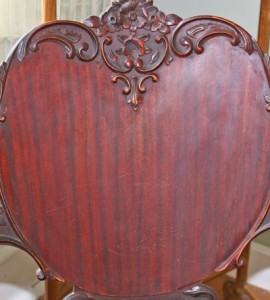
 The full collection of four is shown together, below. Three of them have prominent griffin finials and striped mahogany backs (not sure if this is Honduran or some other region's mahogany - the woodworkers of you out there should know). One has an inlaid seat back while another has relief carving with a crown topping the crest. This latter chair does not have griffin finials.
 A photo below, shows the type of Mahogany seen across these chairs. These chairs were also available in quartersawn Oak.
 The arms on three of these chairs have a distinctive 3-ridge indentation ending in a cylindrical volute. The griffin and the chair arm are in two pieces, with the split occurring at the apex of the curve where the back and arm separate, except on the reference chair. The reference chair has additional decoration on the side and lacks the triple ridges. Obviously the three right chairs are identical in their arms, but unfortunately the design of the reference chair is different. The similarity of the reference chair arm stops with the form, shape and volute.

All 4 seat bottoms have a set of traits that are consistent. The are all marked with white chalk and gray/black numbers, letters, and in some cases, words. The dark exterior stain is absent from all but the edges. The most distinctive comparative trait is at the center of each chair, where there is a lighter, small rectangular spot just large enough for the stenciled model number to be seen clearly. The reference chair is upper right.
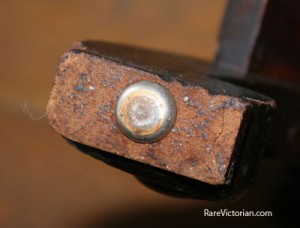
 Although the protective feet are not distinctively unique in the furniture world, they can demonstrate some additional uniformity across the chairs. The feet on three of them look like what is below, with the exception that the inlaid back chair has a black artificial center instead of uniformly being made of metal. (The fourth is the rocker). The reference chair feet matches the non-griffin chair.
The top two chairs have identically carved seat backs, while the reference chair appears to be done in the same "hand" - just a differing design. The open center design with the carved perimeter calls attention to the the striped mahogany. The top right image shows a seat back that is inlaid with a lighter wood and what appears to be abalone accents.

My conclusion is that althought the reference chair is of a different scale, as is often the case where manufacturers have various models and price levels (The 1904 Robert Mitchell catalog is an example of this), there are individual elements that add up to support the case that these chairs are from the shop of RJ Horner.
2 comments