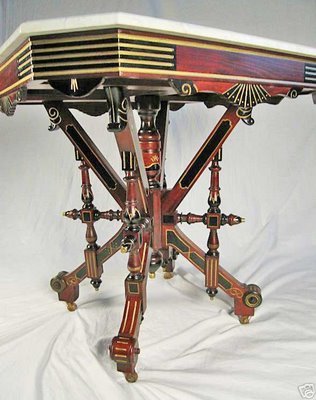
 Here's a great Eastlake table that looks like it just came off the showroom in 1875 and I think it looks quite wonderful. The question is whether you want it to look gorgeous or like it should look 130 years later? My guess is that this table probably looked like someone threw it out a window before they went to work on it - at least I hope so, since it is completely redone. The question is whether Rare Victorian readers hold out for pristine original pieces or are happy to put a fully restored piece in their home?
Bidding for this table starts at $948 and ends on February 10th.
Let me know your thoughts by hitting "leave a comment" below. If you are reading this via your email, click through to the site to comment.
Here's a great Eastlake table that looks like it just came off the showroom in 1875 and I think it looks quite wonderful. The question is whether you want it to look gorgeous or like it should look 130 years later? My guess is that this table probably looked like someone threw it out a window before they went to work on it - at least I hope so, since it is completely redone. The question is whether Rare Victorian readers hold out for pristine original pieces or are happy to put a fully restored piece in their home?
Bidding for this table starts at $948 and ends on February 10th.
Let me know your thoughts by hitting "leave a comment" below. If you are reading this via your email, click through to the site to comment.
eBay Antiques No. 185
How Original Do You Want It?
Here's a great Eastlake table that looks like it just came off the showroom in 1875 and I think it looks quite wonderful. The question is whether you want it to look gorgeous or like it should look 130 years later? My guess is that this table probably looked like someone threw it out a window before they went to work on it - at least I hope so, since it is completely redone. The question is whether Rare Victorian readers hold out for pristine original pieces or are happy to put a fully restored piece in their home?
Bidding for this table starts at $948 and ends on February 10th.
Let me know your thoughts by hitting "leave a comment" below. If you are reading this via your email, click through to the site to comment.
10 comments
Leave a comment
Related archive entries
Antique Searches Fixed
I haven't been using the Antique searches here on Rare Victorian ("Buy Antiques" link at the top of the page) in a long while and what I didn't know as a result is that most of them were broken. eBay changed the way the
No Reserve - Signed Alexander Roux Bed
You don't come across a signed, Rosewood Alexander Roux bed for $2k that often (current price with no reserve). It's not an overly grandiose bed in size or sophistication of design, but the carvings are exceptionally wel
Thanks for your website and your interesting articles. I don't have time to write often, but I do enjoy reading the very interesting material. I've learned a lot from the site and have a much better/deeper appreciation of Victorian furniture. Thanks.
BornaHeel
Oh! Tonight's the night: Go Heels. Beat Duke.
Great website! Just love it and visit it almost everyday. Keep up the good work--you definitely keep me informed and continue to educate me on Victorian furniture.
Here's the one I bought a few years back:
http://hunzinger.blogspot.com/2006/07/why-refinish.html
I would bet very big money that this is the same table that AC Antiques was selling as a reproduction about 6 years ago. As I recall, they were offering this "faithfully reproduced" table and a smaller repro candlestand sort of table. I thought about buying one back then (it is very pretty, afterall), but, hey, why buy a repro?
As an aside, I don't think that I have ever seen an old marble top with the same edge profile as this one (the hard chine at the top surface--before becoming a curve). Also, in addition to every surface looking BRAND NEW, the grain of the wood doesn't look as tight as what I would expect...and I would expect a veneer panel/strip, maybe of burl, in those areas just under the marble top centered between the gilt-&-ebonized horizontal stripes.
...just my opinion...
- Jason
A second issue aside from the normal 150 years of wear and tear, are the problems related to previous amateur repairs that are encountered in perhaps 80 percent of the furniture I deal with. I literally spend more time attempting to correct bad restoration work than any other activity. My wife often will find me in the shop cursing and complaining about the damage a well intentioned person has inflicted on a piece, that has aggravated the original defect, caused other problems in the process, and now made it much more difficult to correctly restore.
Unfortunately the sad fact is most antique furniture you will encounter is not in the original condition. A correctly done restoration will attempt to remain as true to the condition the piece was in when it left the factory as possible, yet still retain the history of a century or more of use. This is the balancing act and dilemma that the restorer faces, as these two issues can be mutually exclusive.
Michael
A side note about repairs that Michael mentions done to correct "damage a well intentioned person has inflicted on a piece, that has aggravated the original defect" - my repair guy calls these a$$h0le fixes that need to be re-repaired.